Warning: Constant FS_CHMOD_DIR already defined in /home/digitalw/rhetoricofgaming.digitalwcu.org/WeeklyWriting/wp-config.php on line 101
Warning: Constant FS_CHMOD_FILE already defined in /home/digitalw/rhetoricofgaming.digitalwcu.org/WeeklyWriting/wp-config.php on line 101 Uncategorized – Page 2 – Weekly Writing for Rhetoric of Gaming F2017
Learning to Play: Exploring the Future of Education with Video Games
Khine, Myint Swe. Learning to Play: Exploring the Future of Education with Video Games. P. Lang, 2011.
This book acts as a critical analysis of trends in educational gaming, while also informing the reader of examples that one might not already be aware of existing. It approaches the subject matter from various perspectives, exploring the latest innovations while looking toward the future. The articles notes the success of video games as a pedagogical tool in the military, while continuing to have a relatively low rate of use in grades K-12. The article also notes potential challenges, such as off-task behavior in students and overemphasis of technology, while praising the social nature of gaming. The author has also written other books on technology and learning, and very obviously takes his work very seriously.
Robbins, M. Brandon. “Puzzle It out.” Library Journal, vol. 141, no. 7, 15 Apr. 2016, p. 60. EBSCOhost, proxy-wcupa.klnpa.org/login?url=http://search.ebscohost.com/login.aspx?direct=true&db=a9h&AN=114555334&site=ehost-live&scope=site.
As far as academic research goes, this article felt pretty lacking. There wasn’t any research cited to help further the point of the article or establish any credibility. The writing wasn’t even that in depth and took most aspects of the game at face value. The article overall felt like it was written as an editorial piece in a newspaper. After re-reading the article for the third or fourth time, I felt a little bad about myself for enjoying it so much on the first read because it doesn’t really have much to offer. I still think the article made some successful points about the game it mentioned. I think it was successful in bringing the sense of a puzzle being hidden within a first person shooter game to light by providing examples and descriptions of the game-play. The article still needs to cite some academic, peer-reviewed research to gain any credibility regarding these points.
Super Mario Odyssey is the latest installment of the long-running Super Mario series of games. The game has been well received, noting it’s adherence to classic Mario themes while breaking new ground for the series. In particular, the environments are more complex and featuring scenery not unlike New York City. This may have been a conscious choice, as the improved engine allowed by the improved hardware of the Nintendo Switch allows for more immersive environment with more moving parts. Interestingly, as one Polygon article notes, the gameplay does not very often “punish” the player. There are no lives that would result in a game over, and the player only loses a minimal amount of coins. This was an interesting choice, as one could imagine it being less satisfying to win when you never could fail. However, the article argues that the reward value is not lost with the addition of this no-punishment system. You very well may have to attempt a puzzle over and over, but you will not be too harshly punished for your failure, only set back slightly. The triumph is still there, but the player is not discouraged from play.
Anderson, Craig A, et al. “Supplemental Material for Violent Video Game Effects on Aggression, Empathy, and Prosocial Behavior in Eastern and Western Countries: A Meta-Analytic Review.” Psychological Bulletin, vol. 136, Mar. 2010, pp. 151–173., doi:10.1037/a0018251.supp.
This meta-study reconsiders the idea that exposure to violent video games makes one more prone to aggressive behavior. The analysis of the studies exposes a lack of cohesive information confirming this, and uses restrictive measures to identify the relevant information. The document also features a cross-cultural examination, which is missing from many other studies. This feature reveals slight differences in the effects of video games on the participants depending on factors such as age.
Resident Evil’s Rhetoric: The Communication of Corruption in Survival Horror Video Games by Charley Reed http://journals.sagepub.com/doi/pdf/10.1177/1555412015575363
This article thoroughly analyzes the effectiveness of Resident Evil’s infliction of terror upon the gamer. I’ve always known Resident Evil to be a horror game but I found new aspects in this article that I’ve never though of. What the article does best is just that, it goes past the normal factors of a horror game and analyzes the small and minute details that add to the terror that most gamers would even notice. The fact that the author notes the process of finding information through physical objects shows the real interest and investigation this author dealt with to complete this article. Citing something I would have never thought of gives the impression that the author really delved into the substance of their knowledge and the corresponding game. Writing about the idea of corruption in the game also gives the author credibility. Anyone can note that the surroundings in the Resident Evil games are creepy because they are dark, mysterious, and just all around creepy. This author goes in depth about the corruption of nature, architecture, and relating characters that cause the overall feeling of terror. The depth of their discussions establishes the authors credibility and gives the impression that the author really wants to investigate the game deeply.
Zoe Quinn. Depressionquest: An Interactive (Non)Fiction About Living with Depression. www.depressionquest.com
This game is not like most games played by teens or adults. Depressionquest is type of simulation game that gives people the opportunity to understand how the mind of someone with depression works. While going through the game, some ‘choices’ are crossed out in red and not clickable, but the player can still read what is there. Although the player may want to choose what is crossed out because they do not have depression in real life, the game makes the player realize that it is not even an option for a person suffering from depression. This aspect of the game helps the player better understand the thought processes of someone with depression and how this disease affects their way of thinking.
Juuls, Jesper. “A clash between game and narrative.” A clash between game and narrative, www.jesperjuul.net/thesis/.
This essay by Jesper Juuls attempts to explore the idea of narrative within game as a form of interactivity, and whether or not games that are narrative-driven, such as interactive fiction, can be constituted as games. While not specifically tied to any works, Juuls’ piece helps to set the foundation for the general concept of a game and the concept of interactivity as a form of play. For this reason, I choose to include it as further cement on the foundation that is our collective definition of the game and of play.
In this portion of Bogost’s article, he attempts to explain procedurality in video games as the necessary constraints that define a game’s parameters, as well as its limitations. The concept of process intensity, understood as how a procedural game utilizes process over data, comes with the notion of meaningful expression, and defines a game as a form of artistic expression, rather than a tool like a spreadsheet or word document. What I fail to notice, however, the ways that procedurality impact the player and the player’s interaction with the game. The concept presented here only seems pertinent to the game itself, and the relationship between game and player falls to the wayside. If we are to understand the act of play as a meaningful interaction between gamer and game, then we can’t talk about the processes that make up the game without talking about this critical relationship. Regardless, Bogost’s idea of procedurality as the separation from tool and game is both plausible and accurate, in my opinion.
Topic Proposal, containing a topic, a working thesis, and at least one primary (game object) and secondary source shared via the weekly blogs, no later than 1159 9/29 (5%)
Presentation of topic proposal, in class 10/3 (5 %)
Defense of topic proposal in conference with me no later than 10/3 (5%)
A draft project overview with a thesis and and no fewer than 200 words, shared on our weekly blogs no later than 10/6 (5%)
Commenting on two other writing projects via the blogs, on or before 10/8 (5%);
A draft conference with me, on or before 10/6 (5%)
Another draft conference with me, showing a substantially finished draft of the project, on or before 10/13 (5%);
A near-final draft, shared/linked from a post on our shared blog, on or before 10/13 (5%);
A final round of commenting on two drafts, due on or before 10/14 (5%);
At first glance, each of the original Metroid titles tell the same story. Bounty hunter Samus Aran is contracted by the Galactic Federation to investigate an alien threat. Isolated in an alien world, she fights for survival as she explores seemingly endless interconnected labyrinths. Obviously, these are not the same games, but why? The answer, as I will explore, comes from how the game allows the player to play. Though each of the games looks nearly identical–even the 8-bit NES version draws from the same inspiration—and the formula untouched, each game feels different.
(Perhaps analyze the visual and audio differences here)
When it comes to analyzing the rhetoric of games, one must explore beyond the visual, auditory, and textual aspects of the medium. Video games are unique in that they convey themselves to the player through the act of play. As Bogost points out, the imagined systems the player inhabits are explored procedurally “by imposing sets of rules that create particular possibility spaces for play”. In a sense, the freedom of play is defined and facilitated by the rules and restrictions that create the play space. Understanding games as a system of rules is what Jasper Juul––and many other game scholars––calls a formal system. This formal system is the structure that game developers create, and it serves as the bones for gameplay. But, the formal system is essentially a dead space until it is interacted with by the player.
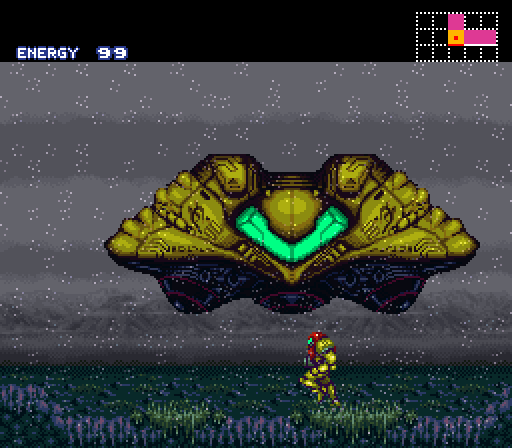
But what exactly is the space of play? According to Huzinga, “The space of possibility of a game is a plane stretched between two anchorage points: the beginning and the end of the game….In a well-designed game that supports meaningful play, this journey between points should be taut and efficient, with every element contributing directly or indirectly to the larger experience” (chapter 20 p9). Super Metroid drops the player into its world, and with almost no direction, and free range to explore. Through procedural play, the player can become quickly assimilated with the games rules and figure out a general idea of where to go through hints from the formal system of the game. Meaningful play arises from exploring unknown territory, finding insurmountable obstacles, continued exploring, finding items, and returning with the items to progress. At its core Super Metroid is an adventure game, not unlike it’s predecessor Adventure for the Atari 2600. (Insert picture of Adventure).
Horror is a tone aspired for in each title, but the way it is conveyed varies. In Understanding Video Games as Emotional Experiences, Aki Jarvinen Identifies the ways in which game systems ellicit emotions from the player. This is in part because the outcome of play is unknown to the player, creating tension.
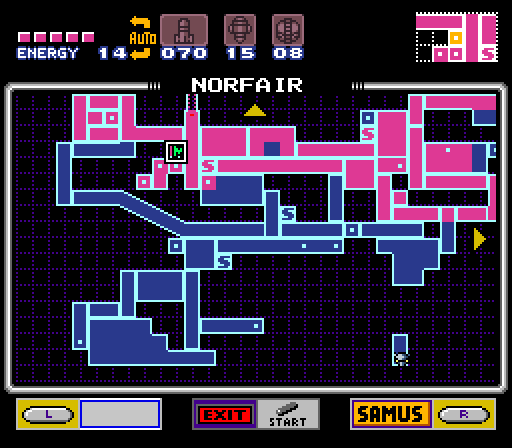
Super Metroid Norfair map
For Super Metroid, this tension comes largely from exploring unknown territory. With no direction, the player must make their way through the game on their own. This sense of being lost creates feelings of isolation and confusion.
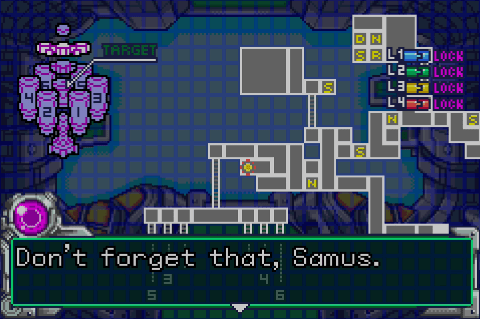
Metroid Fusion hub world map
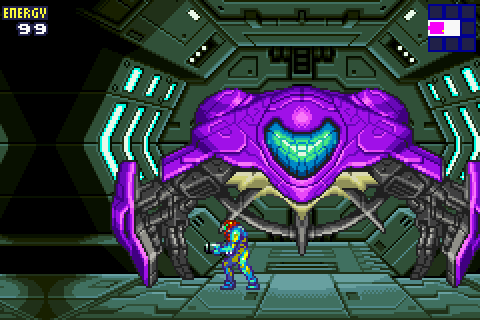
Fusion is much more linear though. The level design is much easier to navigate and your progress is facilitated by waypoints on the map and a narrative largely told to you by a computer that briefs you on your missions. This “on rails” gameplay removes the suspense created from getting lost in exploration, but allows for new emotions to be elicited. As stated earlier, the parameters of a play space define the experience of playing.
Project 1 process checklist:
Topic Proposal, containing a topic, a working thesis, and at least one primary (game object) and secondary source shared via the weekly blogs, no later than 1159 9/29 (5%) – YES
Presentation of topic proposal, in class 10/3 (5 %) – YES
Defense of topic proposal in conference with me no later than 10/3 (5%) – YES
A draft project overview with a thesis and and no fewer than 200 words, shared on our weekly blogs no later than 10/6 (5%) – YES
Commenting on two other writing projects via the blogs, on or before 10/8 (5%); – YES
A draft conference with me, on or before 10/6 (5%) – YES
Another draft conference with me, showing a substantially finished draft of the project, on or before 10/13 (5%); – YES
A near-final draft, shared/linked from a post on our shared blog, on or before 10/13 (5%); – YES
A final round of commenting on two drafts, due on or before 10/14 (5%); – NO?
The concept of a game is rooted in the idea that, as an item of play, the player interacts with the game in a way that is both meaningful and authentic. The player needs to be inserted into a simulation, make meaningful choices within the game, and engage in play. The question, then, is that do we engage in play, and therefore participate in a game, when we interact with a very particular type of media- an interactive novel? We see numerous examples of interactive novels on the web today, and many we would not consider to be true games, but rather a sort of literature for a more active audience. One studio, however, attempts to break that mold, and market the concept of the interactive novel as a game. The studio in question, Telltale Games, has multiple different series linked to several different pop culture items, including Batman, Guardians of the Galaxy, and Game of Thrones. But while they sell these pieces of media as games, do we really play them? In the following passage, I will attempt to explore this idea of an interactive novel as an item of play, utilizing the Telltale Games’ various works as examples of interactive stories marketed as games, and ultimately answer the question of whether or not an interactive novel, at the magnitude of Telltale Games’ works, can be considered a game.
For my project I will be working with prompt number 4, “Games and Life.” I hope to prove the value video games for developing life skills, as well as the format’s unique approach to storytelling and the maturity of the narratives of many popular games. I will be referencing the various studies proving video games’ positive effect on critical thinking skills, and noting the mature writing and literary illusions of games such as Fallout 4 and Bioshock. While I expect to run into some trouble exploring the intricacies of such a relatively new format, by narrowing my focus I hope to produce a mature and extensive commentary.
For my topic, I will be choosing imte number 4, “Games and Life”. There are a plethora of games in the world today that have lessons we can incorporate into our very lives. Unfortunately, the stigma exists that games are nothing more than a time-waster, and many individuals believe them to be a waste of time. For my project, I hope to explain, through the use of a number of games and articles, that the art of video games is more than just a way to entertain and waste the time of the player. Instead, the game can act as a medium for developing life skills and learning valuable lessons about the world.
Game: Metal Gear Solid 3: Snake Eater
Article: Eberle, Scott American Journal of Play, Rochester 6.2, 2014. (214-233)
Recently, a new game called Cuphead has taken the gaming world by storm. It’s a simple game that seeks to incorporate elements of classic cartoons, such as Steamboat Willie, and bring them to a modern bullet-hell shooter game. I really enjoy how even individuals who’ve never watched those style of cartoons are able to enjoy the beautiful artwork and soundtrack, and those who did experience that cartoon style are filled with nostalgia and awe.
For this first project I aim to explore the ways the player inhabits the subjectivity of bounty hunter Samus Aran. Throughout the series, a balance of action and exploration form the basis for gameplay. Super Metroid is the quintessential example of this, allowing the player to explore a vast interconnected subterranean world, shoot aliens, and discover weapons upgrades which improve your in game abilities. Metroid Fusion, while staying true to its base gameplay tropes, feels almost entirely different. The world is more linear, Samus is more stripped down than ever, and your in game progression is more narrative based. This has huge implications on the way one plays Fusion. After expanding on how these differences change the space of play, and thus how the player experiences play, I will also explore how these differences found their way into the newest addition to the series, Samus Returns. To help me, I will incorporate the Ideas of Sebastien Genvo from Chapter 7 of the Video Game Theory Reader, titled, Understanding Digital Playability.
For the first project, I plan to use the “Play and the Player” prompt to explore the player’s relationship to both their character and to the game world in assorted RPG’s. In particular, I wish to examine how through the creation of an immersive game-world and play system a game temporarily creates a new identity for the player that subsumes the player’s real world identity for the duration of play. The game’s through which I plan on exploring this are open-world rpg’s like Skyrim and the Fallout series, and more narrow rpgs like Dragon Age. A quick search uncovered a wealth of information on Skyrim, with articles like “Unbroken Immersion: The Skyrim Experience” (Simkins, David, Seann Dikkers, and Elizabeth Owen. “Unbroken Immersion: The Skyrim Experience.” Well Played–Vol. 2, No.: 13.) being ubiquitous.
For our first project, I plan to explore the topic “Games and Life”, and how games can be used as a learning tool for relationships, and decision-making in the real world while broadening social and cultural knowledge. The technology of gaming today allows people to easily be connected across the globe. Playing massive multiplayer online role playing games or MMORPG allows for this. Role playing games allow the players to choose an avatar and create it how they would want to be depicted in the game, having specific skills and character development as the game moves along, like in World of Warcraft. I will be using this game along with a card game, Magic, and board games as my three sources.
I also plan to talk about how the mind creates games for itself during certain situations, such as when wanting to succeed or “win”, and gain the feeling of pleasing someone. As Huizinga states, “play is older that culture” and is a part of nature (Huizinga 2). Play is necessary whether someone is conscious of the play they’re participating in or not.
Source: Huizinga, Johan. Homo Ludens: a Study of the Play Element in Culture. New York, Roy Publishers, 1950
Secondary Source: Wang, Chee Keng John, et al. “Passion and Intrinsic Motivation in Digital Gaming.” CyberPsychology &Amp; Behavior, vol. 11, no. 1, 2008, pp. 39–45
One game source: Blizzard Entertainment. World of Warcraft: Mists of Pandaria. Activision Blizzard, 2012. Online.
Video games are an outlet for people of many different ages to learn a diverse amount of skills and vast information that is useful in everyday life. Video games can teach us cognitive skills, history, creativity, and sometimes about mental illness. They teach us in an interactive fashion that draws the player into a fun and immersive world without feeling like a learning experience. I will prove this point through explaining different games and their corresponding aspects of play that seek to teach players. Games like Destiny 2 or Overwatch (Teamwork), Hellblade (Psychosis and Mental Illness), Fable (Sense of morals), Assassin’s Creed (A loose base of history), Civ Rev (Strategy), Portal (Spacial Awareness, Problem Solving), Dark Souls (Motivational), and Minecraft (Creativity) can teach players many different things. Using these examples, Isabela Granic’s article “The Benefits of Playing Video Games” among other articles, and my own personal experience, I can show how video games directly teach players.
When I first glanced at the syllabus and noticed we were going to be reading The Enchiridion, I was curious as to how it would factor into our course on the idea of play and the game. As far as I was aware, the Enchiridion was a manual for the best way to live life in Greek culture. So that got me to think, “Did the Greeks consider play an essential part of life?” And if so, why did they find play to be so important? Much of The Enchiridion supports the notion that life, itself, is one colossal play, with all of us playing small parts. A culture that supports that kind of notion would almost certainly support the idea that the act of playing is, in it of itself, essential to life. Other parts of The Enchiridion, however, support the idea that being playful and frivolous in life is shameful, and should be frowned upon. So what, really, is this piece trying to say about play? Or, rather, to what extent do we allow ourselves the freedom of play?
Cards against humanity is a card game for young adults, or even older generations to have fun and play a game without too much seriousness. The cards use obscene language and scenarios to make the game humorous and easy to laugh with friends and family. However, this quality of the game may not appeal to every type of personality. Someone may be at the age appropriate to play this game, but may not find this kind of language funny, thus taking away from the play of the game for that specific person.
This rhetorical strategy for a game can be risky, but it allows a group of people to bond and laugh together as many games do. The obscenity of the game allows one to get a look into a completely different side of a person that may not be revealed in casual or professional conversation. Their type of humor or lack there of is revealed. The game causes the players to want to be their funniest so they can win and be picked as leader of the next round.
I propose that the advent of ubiquitous (pervasive) play goes hand in hand with transmedial discourses, as both have real world distinctions. Though ubiquitous gaming is still continuously being defined, it harbors a blurred line between created reality and actuality, often incorporating a mix of both to sufficiently and mimetically create the most interactive game possible. However, this hybrid play has fueled modern escapism, and the potentially undefined boundaries this genre could parallel the likes of recent sci-fi horror (I, Robot, The Terminator series, Ex Machina, etc). Though real world consequences might not currently be so exaggerated, the lack of cemented lines has already influenced contemporary society, and therein a game becomes reality. The network that this dual united front creates eradicates the tacit understanding of play being a gateway leading to an anti-ordinary life, and therefore creates a paradox between the codes of play, and the necessity of reality. Using examples of well known transmedial and ubiquitous games, I will investigate this ongoing complexity and its potential consequences.
Primary resource:
Pokemon Go http://www.pokemongo.com/
Secondary resource:
McGonigal, Jane. “This Might Be a Game: Ubiquitous Play and Performance at the Turn of the Twenty-First Century.” AvantGame, Univesity of California, Berkeley, Jane McGonigal, 2006, Accessed 23 Sept. 2017.
Eberle, Scott American Journal of Play, Rochester 6.2, 2014. (214-233)
A lot of what Scott Eberle says in this article are similar to what we heard from Huizinga and various other authors on the discussion of play. However, Eberle offers a few very distinct differences in his definition, namely the idea that play can simply exist without pure purpose. I feel.that conflicting ideas of this nature lend to a more thorough understanding of play as a whole, and for that reason his article resonates well with me, and is a good addition to our collection.
Ostenson, Jonathan, and Lisa Fink. “Exploring the Boundaries of Narrative: Video Games in the English Classroom.” English Journal, vol. 102, no. 6, 2013, pp. 71–78.
Jonathan Ostenson wrote an article called “Exploring the Boundaries of Narrative: Video Games in the English Classroom.” In this article Ostenson writes about video games as interactives narratives. He describes how video games can leave the same feeling and thought often brought on by books and novels. Ostenson states, “The games of today have come to rely more and more on the elements of fiction in their design, and they represent unexplored territory in studying the nature and impact of narrative.” Ostenson reviews various reasons that people have suggested video games be implemented into the English classroom before introducing his own reason. Ostenson believes that video games represent some of the most inventive and important storytelling in the 21st century. More and more English teachers have been teaching diverse media and Ostenson believes video games is a new forma storytelling media. He identifies different games and explains their narrative purpose. He even believes that the simplest games have a narrative, for example, Angry Birds. He spend the rest of his paper explaining different purposes and methods that teachers can use to teach video games to their students. He lists different techniques teachers can use and different types of video games that they can teach.
I intend to explore the idea that video games provide an outlet for each player to construct, observe, and alter versions or reflections of their own self/subjectivity/ego through the realization of their in-game avatar. This realization includes character creation/customization (designing the avatar), in-game choices/decisions, prioritized activity, speech (personality, style, dialect, etc.), internal dialogue over imaginative processes, performance of player-type characteristics, and so much more. Simultaneously, and arguably inevitably, I will also examine how players construct and critique the subjectivity and identity of other players by encountering their avatars in the game, so that all players are intersubjectively perceiving representations of each other through their interactions. I expect to use mostly role-playing video games (especially online ones) in my endeavors with this project.
Primary Source: Runescape 2 (Old School Runescape)
Secondary Source: Matheson, Calum. “Procedural Rhetoric Beyond Persuasion: First Strike and the Compulsion to Repeat”. SAGE, 2014. Web.
An ethnography that may have been the first of its kind, Coming of Age in Second Life follows an anthropologist’s investigation of the culture that has developed in the massively multiplayer online simulation. As the title implies, just as in the real world, players dress their avatar, own property, buy and sell goods and services, attend events, socialize, and even fall in love.
What separates this virtual world from the “real world” is exactly what Tom Boellstorff aimed to decipher during his 2 year investigation in the game. After observing and befriending some of the many thousands of active users, he concluded that in some cases the virtual world experience was more real than some of those in the physical world.
The title then has a double meaning: the virtual world is informed by and modeled after human experience, but also that much of what is “real” about being a human has really been virtual all along.
In the latter half of Huizinga’s Homo Ludens, he attempts to describe play as an element that is both serious and not serious simultaneously.
At one end, the fact that play holds no inherent risk or chance for profit. On the other, play naturally invokes a sense of intensity and tension that forces the player into a more serious state. I feel, however, that in Huizinga’s idea of play being a serious matter, he fails to consider the possibility that a player can play a game simply for the enjoyment of the game. As previously mentioned, play is an essential part of a game, but you don’t need a game to engage in play. However, I’m inclined to believe that the player whose ultimate goal is not winning, but rather to attain the maximum enjoyment possible from the game, plays in an almost tension-free state, as that tension would detract from the ability for the player to have fun. Does a gamer like that fit into Huizinga’s model of gaming and play? I’m inclined to believe that no, they don’t.
Polybius is an urban legend surrounding an arcade game that supposedly had a limited run in select northwestern arcades during the early 80s. The game’s existence has been hinted at in video game message boards and websites since the early 2000s, but no reliable physical evidence has ever been provided by those claiming to own it.
The story goes that in 1981 Polybius was created by a fringe government research group, as a method to test the potential for videogames to stimulate and influence the player’s mind. After claims that those who played Polybius suffered from amnesia, night terrors, and hallucinations, the game suddenly disappeared from all arcades in a massive cover-up.
The gameplay itself is also shrouded in mystery, but a few second hand accounts describe Polybius as a space shooter with puzzle-like elements. The sensory experience is often described as psychedelic, composed mainly of vector graphics of colorful shapes, and with a soundtrack of loud dissonant synthesizers.
Three years after the initial release of Destiny 1, Destiny 2 is far different from it’s predecessor. A common complaint of Destiny 1 was the lack of story and the repeated play. Multiple missions consisted of the same layout over and over; find a certain object, defend it while it’s analysed, and boom – rewards. Besides solo campaign missions, there was also competitive multiplayer, co-op strikes which are longer, more difficult missions, and raids which are even longer missions with incredible bosses and painstaking puzzles. The majority of the game was based around team work and puzzle solving where some times those lines blur. In Destiny 2, the teamwork aspect has been dialed up to 11. Certain factors have been changed in the multiplayer to make cooperative fighting more prevalent and required in the game. The soon to be released raid in Destiny 2 will also amplify the need for teamwork among fire-team members for teams up to six. Teamwork is the main source of reward in the game whereas the best rewards come from the modes with the most amount of teamwork needed.
Tania Smith’s definition of rhetoric basically claims that it is human communication used in a strategic manner in order to persuade or inspire another human (although there could probably be an argument that rhetoric can also be used on the self, though I digress). She claims that rhetoric is used by everyone, even though some people try to give it a negative connotation. This was of particular interest to me, since it implies that most people conflate rhetoric with propaganda (which, in itself, is rhetoric). Smith additionally points out that act of defaming rhetoric would additionally be an example of the usage of rhetoric, since it’s an attempt to deliberately influence the ideals of others.
Smith tries to make the assertion that rhetoric is best used for good purposes. While that is a noble goal, I believe that rhetoric is neutral, without begin inherently good or evil. Smith attempting to convince the reader that rhetoric ought to be used for good purposes is in itself an interesting usage of rhetoric in a piece about rhetoric.
In “What is Rhetoric?” the author is employing rhetorical strategies for functions beyond the obvious objective of defining rhetoric. In particular, the author attempts to establish her credibility as a member of the academic community, thereby strengthening her authority on the subject of rhetoric.
The author begins by noting the many varying definitions of rhetoric, but authors her own definition, “as a scholar of rhetoric.” While she does link to a Stanford webpage, which now redirects to the homepage, most of her argument stems from her own definition. This implies the authority held by the author on the subject of rhetoric.
Further, the author also replies to feedback, answering questions in definite terms, again implying her authority on the subject. In this instance, however, she interacts directly with her audience, breaking the barrier between author and audience, who she feels qualified to educate. This article contains many large assertions, such as the definition of rhetoric and its most moral method of use. The very publishing of the article functions to establish the author’s credibility on the subject of rhetoric.
The other day friends of mine made me play Overwatch with them. It is a first person shooter game and each round you have certain objectives, but the main point of the game is kill or be killed. I have only played the online multiplayer version so I do not know if there is a story mode. My view of the game is that you just have to kill everyone so that they don’t kill you that as a lesson on society could be quite scary. I am curious to see how other players of the game would interpret the rhetoric of it. I prefer to play games that have some sort of story to tell, but Overwatch doesn’t seem to have that. The characters are very complex but there isn’t a story so it make it to me seem as though it is o, but Overwatch doesn’t seem to have that. The characters are very complex but there isn’t a story so it to me seem as though it is only for entertainment purposes. I know it can’t be for purely entertainment so I would like to see what other people think about the rhetoric within Overwatch and if it has a deeper societal meaning.
Smith succinctly details her own definition of what rhetoric is, including the various cons and pros to the discourse, along with how it functions en masse, generally. However, she fails to denote with any real accuracy the actual substance with which she is creating purposeful literature. She fails to see rhetoric as a potentially global and temporal currency, instead focusing on the divisive natures and “should nots” of said institution. Her definition does not account for the adhering and connective aspect of rhetoric. Though she does mention the ever pervasive and often overlooked nature of everyday rhetoric, along with the stigmas that educated rhetoric carries, she does not highlight the great potential that said discourse holds and stores. If rhetoric can be and is any endless forms of communication, then why not focus on that unfettered network? It of course goes without saying that any and every discourse will face barriers and judgments, but rather than investigate those walls so closely, instead extrapolate on what one currently has in the hopes of glimpsing a more connected “possibility”. For there is an unformed possibility of the future, immediate and distant, that exists for every thing present, and to harness that knowledge, to accept the infinite potentiality and delve into the world of rhetoric itself, with that open ended mindset, would be infinitely more altruistic and enlightening. Overall, Smith fails to explain the vast tethering aspect of rhetoric, with her definition focusing too much on what she currently has concretely, not what we all could have potentially.
Smith’s definition of rhetoric functions as a way of denying and defaming those who she claims “deny and defame [rhetoric]”, implying that such individuals that are anti-rhetoric are hypocritical, and use rhetoric the most. In implying this, Smith argues that anti-rhetoricians are the ones that use rhetoric in the most effective fashion. The almost oxymoronic nature of rhetoric is never overtly mentioned by Smith, but is implied through the connection of two of her main points in her article.
When Smith mentions the most effective rhetoric being that which is not consciously applied, it is directly related to the type of people she discusses when she says that people who are against rhetoric use it all the time. Although Smith does not have these ideas directly placed next to each other in her article, simple logic allows readers to draw the conclusion that she see’s rhetoric as counterproductive to those who view it in a negative light.
If this is true that those who are against rhetoric can be the most effective at using it, that then must mean that those who are conscious of their use will be far less effective, at least if going by what Smith has presented in this article.