Warning: Constant FS_CHMOD_DIR already defined in /home/digitalw/rhetoricofgaming.digitalwcu.org/WeeklyWriting/wp-config.php on line 101

Warning: Constant FS_CHMOD_FILE already defined in /home/digitalw/rhetoricofgaming.digitalwcu.org/WeeklyWriting/wp-config.php on line 101
NICHOLAS – Weekly Writing for Rhetoric of Gaming F2017

Project 2 Final – 3001 A Space Story

http://www.flowlab.io/game/play/771503

Preface to 3001 A Space Story

My game is supposed to represent an emergent system, one that arises out of a single urge: progression. I wanted to represent that urge through the act of play. More specifically, the act of playing a 2D platformer. As such, I wanted my game to utilize all the tropes that we are accustomed to expect in a game of this genre, and even bend them a little. I hope that my game brings these tropes into consciousness, while also bending them slightly, making a larger commentary on the idea of progression in play itself.

The idea for this game came to me while I was developing a basic platformer, so I could learn the basics of the program I was using, Flowlab. I created two levels and connected them with an object that would bring the player to the next level when touched. I had no third level to connect the second level to, so I just connect the second one back to the first. For some reason this reminded me of one of my favorite movies, 2001: A Space Odyssey. I always interpreted the ambiguous ending of that movie as an emergent system, where Dave transcends and becomes the interstellar force that places the first monolith that starts the movie. This of course is just my interpretation, but regardless, I then had the idea to adapt this movie to the pixelated screen.

I then created a mock up of the first level, a recreation of the first scenes in that movie. I created all the sprites and designed the level to look like the movie, but I didn’t know how to tell the story of that opening scene within the gameplay. In the movie, the early-human apes have conflict over a water source, and the larger and more intimidating apes scare the others away. The group that is kicked out is later visited by the mysterious monolith, which imparts hidden knowledge to one of the apes. He then learns how to use tools, using a bone to smash things. With this knowledge he returns to the water source and beats one of the rival members, scaring them away and reclaiming the territory. Unsure of how to tell convey this scene in a 2D platformer, I recalled the standard tropes of the genre. In platformers, the player usually moves right and jumps on enemies to kill them. So here, the tool of domination was the ability to jump. So I took the significance of the bone-tool, and placed it in that ability. In order to make the player feel weak without that ability, I needed them to fail without it, so I designed the first encounter to be impossible. Upon starting the game, the player would seek to progress, inevitably moving right, but that progress would be halted by an enemy ape which you could not kill. After enough tries, the player would decide to seek progress elsewhere and move explore the left. Here they would learn how to jump, allowing them to progress through the rest of the level. I wanted to convey the confusion and frustration that comes from an obstacle, and the aha moment that comes from knowledge gained through exploration.

The game then becomes one of domination which is common of games in the genre. The player kills all enemy apes and reclaims the water source for their fellow apes. This is very much a standard game, but also a standard, instinctually rewarding form of progression. Throughout the rest of the game, this form of progression does not return, and instead the player uses their ability to jump for progression, but not domination. As a game, this is much more boring. The player progresses, but with very little threat against them, making that progression much less satisfying. This way another deliberate choice on my part to convey the commentary that Kubrick seems to be making. Our drive towards progression has ultimately brought us further from what makes us human in the first place. The gameplay is somewhat a bore, but the characters in the movie seem profoundly bored with space travel as well.

This is of course until players reach Jupiter and come against HAL. HAL halts the player’s progress not through violence, but through imposition. He controls the doors, not allowing the player to move right, like they are inclined to do. The player must then negotiate a series of tasks in order to overcome him, which allows further progress.

The final level of course flips the idea of progress on its head entirely, placing the player in a room where they can do nothing. With their agency stripped the them, they might run to either side or jump around, but their attempts are fruitless. I wanted the player to feel confused here, and make them question the level and their purpose within in. That questioning would then turn inward, perhaps asking themselves why they are playing my game in the first place. Their reward for this is essentially nothing, and after the level plays itself out, the game restarts. Much like life, progress is subjective and perhaps life should be considered more than a series of objectives to conquer.


  1. Topic Proposal, containing a topic, a working thesis, and at least one primary (game object) and secondary source shared via the weekly blogs, no later than 1159 11/29 (5/5%)
  2. Presentation of topic proposal, in class 11/30 (5/5 %)
  3. Defense of topic proposal  in conference with me no later than 11/29 (5/5%)
  4. An initial draft project in the format it will be submitted (either google docs or web page) linked from the blogs no later than 12/5 (5/5%)
  5. Commenting on two other writing projects via the blogs, on or before 12/8 (5/5%);
  6. A draft conference with me, on or before 12/8, show substantial progress on a drafted project (0/5%)
  7. A near-final draft, shared/linked from a post on our shared blog, on or before 12/13 (5/5%);
  8. A final round of commenting on two drafts, due on or before 12/15 (5/5%)
2001 game further progress!

https://flowlab.io/game/view/771503

Hey guys!

Here is a rough outline of what the general flow of my finished product is going to be. Designing a game is much harder than I anticipated, so through all my work I have only been able to create most of the assets and sprite work. I’ve been toying with some game design ideas in another in another game and will be taking some of those ideas (most haven’t worked or were difficult to get running smoothly.

I’ve also completely completed the level for the final scene of the movie, but I’m holding out on that for now. I think fans of the movie will get a kick out of it.

Let me know what you guys think so far and hit me with some suggestions!

Thanks,

Nick

P.s. The second level is a work in progress (sorry). The rocket ship you start out in will look for like one soon.

Rough Game!

Here’s the link to my very rough game.

I have changed my approach for this project entirely. I am now using a simple designing software that doesn’t require coding (thank god…) to create a side scrolling adaptation of 2001: A Space Odyssey. 

“How will he do it!” you ask. Well, I’m not entirely sure myself but i have a general idea that i am working on. Here is the very rough first level which I hope demonstrates what I want to accomplish with this game. It it isn’t running smoothly, refresh the page.

I’ll be working on this pretty much daily, so depending on when someone uses this link, the game may be extra glitchy or unfinished.

Thanks!

Project 1 Second Draft

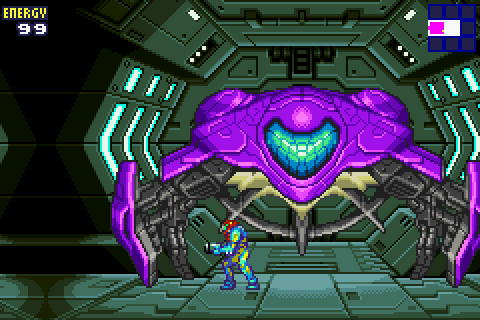
At first glance, each of the original Metroid titles tell the same story. Bounty hunter Samus Aran is contracted by the Galactic Federation to investigate an alien threat. Isolated in an alien world, she fights for survival as she explores seemingly endless interconnected labyrinths. Obviously, these are not the same games, but why? The answer, as I will explore, comes from how the game allows the player to play. Though each of the games looks nearly identical–even the 8-bit NES version draws from the same inspiration—and the formula untouched, each game feels different.

(Perhaps analyze the visual and audio differences here)

When it comes to analyzing the rhetoric of games, one must explore beyond the visual, auditory, and textual aspects of the medium. Video games are unique in that they convey themselves to the player through the act of play. As Bogost points out, the imagined systems the player inhabits are explored procedurally “by imposing sets of rules that create particular possibility spaces for play”. In a sense, the freedom of play is defined and facilitated by the rules and restrictions that create the play space. Understanding games as a system of rules is what Jasper Juul––and many other game scholars–­–calls a formal system. This formal system is the structure that game developers create, and it serves as the bones for gameplay. But, the formal system is essentially a dead space until it is interacted with by the player.


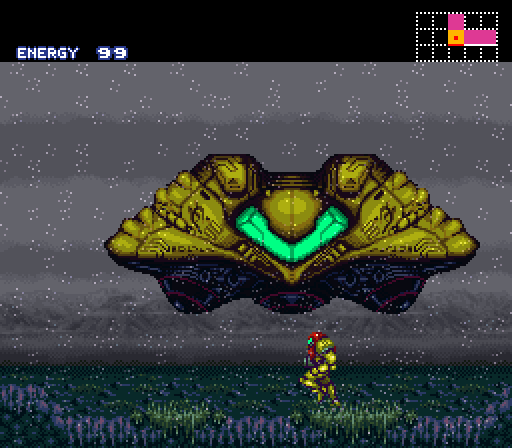
But what exactly is the space of play? According to Huzinga, “The space of possibility of a game is a plane stretched between two anchorage points: the beginning and the end of the game….In a well-designed game that supports meaningful play, this journey between points should be taut and efficient, with every element contributing directly or indirectly to the larger experience” (chapter 20 p9). Super Metroid drops the player into its world, and with almost no direction, and free range to explore. Through procedural play, the player can become quickly assimilated with the games rules and figure out a general idea of where to go through hints from the formal system of the game. Meaningful play arises from exploring unknown territory, finding insurmountable obstacles, continued exploring, finding items, and returning with the items to progress. At its core Super Metroid is an adventure game, not unlike it’s predecessor Adventure for the Atari 2600. (Insert picture of Adventure).

Horror is a tone aspired for in each title, but the way it is conveyed varies. In Understanding Video Games as Emotional Experiences, Aki Jarvinen Identifies the ways in which game systems ellicit emotions from the player. This is in part because the outcome of play is unknown to the player, creating tension.

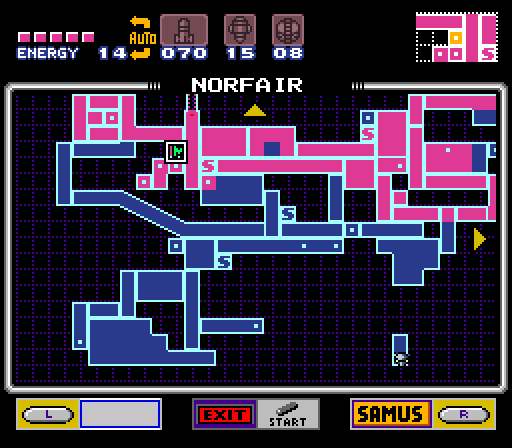
Super Metroid Norfair map

For Super Metroid, this tension comes largely from exploring unknown territory. With no direction, the player must make their way through the game on their own. This sense of being lost creates feelings of isolation and confusion.

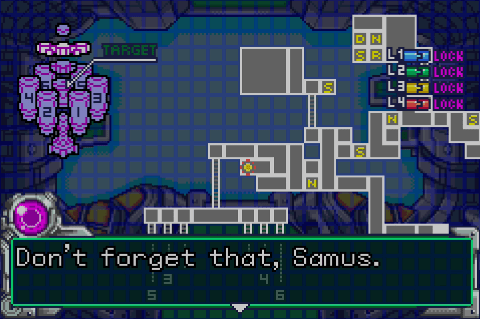
Metroid Fusion hub world map

Fusion is much more linear though. The level design is much easier to navigate and your progress is facilitated by waypoints on the map and a narrative largely told to you by a computer that briefs you on your missions. This “on rails” gameplay removes the suspense created from getting lost in exploration, but allows for new emotions to be elicited. As stated earlier, the parameters of a play space define the experience of playing.


Annotated Bib 10/8

https://books.google.com/books/about/The_Video_Game_Theory_Reader_2.html?id=oe0zNalKkTgC

Understanding Games as Emotional Experiences by Ari Jarvinen

In this essay, the writer points out that game studies needs to be further developed and expand into more experimental areas. In response, he attempts to establish the groundwork for a methodology to examine the emotional responses video games can elicit. He identifies game play as what he calls a “phasic process”, one that mimics the mental processing of emotion. Because of this, games are significant as aesthetic experiences that are shaped by experience based design choices rather than functional design choices. This view of games opens up many possibilities for design techniques that create more diverse experiences for players.

Rhetorical Aspects of Play in the Metroid Series

When it comes to analyzing the rhetoric of games, one must go beyond the visual and auditory. As Bogost points out, the imagined systems the player inhabits are explored procedurally “by imposing sets of rules that create particular possibility spaces for play”. In a sense, the freedom of play is defined and facilitated by the rules and restrictions that create the play space.

Ostensibly, each of the original Metroid titles tell the same story. Bounty hunter Samus Aran is contracted by the Galactic Federation to investigate an alien threat. Isolated in an alien world, she fights for survival as she explores endless interconnected labyrinths. Obviously, these are not the same games, but why? The answer, as I will explore, comes from how the game allows the player to play. Though each of the games looks nearly identical–even the 8-bit NES version draws from the same inspiration—and the formula untouched, each game feels different.

Horror is a tone aspired for in each title, but the way it is conveyed varies. In Understanding Video Games as Emotional Experiences, Aki Jarvinen Identifies the ways in which game systems ellicit emotions from the player. This is in part because the outcome of play is unknown to the player, creating tension. For Super Metroid, this tension comes largely from exploring unknown territory. With no direction, the player must make their way through the game on their own. This sense of being lost creates feelings of isolation and confusion. Fusion is much more linear though. The level design is much easier to navigate and your progress is facilitated by waypoints on the map and a narrative largely told to you by a computer that briefs you on your missions. This “on rails” gameplay removes the suspense created from getting lost in exploration, but allows for new emotions to be elicited. As stated earlier, the parameters of a play space define the experience of playing.

Project 1 Proposal

Play and the Player: Metroid Series

For this first project I aim to explore the ways the player inhabits the subjectivity of bounty hunter Samus Aran. Throughout the series, a balance of action and exploration form the basis for gameplay. Super Metroid is the quintessential example of this, allowing the player to explore a vast interconnected subterranean world, shoot aliens, and discover weapons upgrades which improve your in game abilities. Metroid Fusion, while staying true to its base gameplay tropes, feels almost entirely different. The world is more linear, Samus is more stripped down than ever, and your in game progression is more narrative based. This has huge implications on the way one plays Fusion. After expanding on how these differences change the space of play, and thus how the player experiences play, I will also explore how these differences found their way into the newest addition to the series, Samus Returns. To help me, I will incorporate the Ideas of Sebastien Genvo from Chapter 7 of the Video Game Theory Reader, titled, Understanding Digital Playability.

The Enchiridion

http://classics.mit.edu/Epictetus/epicench.html

The Enchiridion is essentially the 52 commandments of Stoicism. With no introduction, the text begins listing rules that Epictetus believes lead to a good life. Many of these rules read more like anecdotes or analogies that the reader is supposed to extract the meaning from and apply to their own context.

Individual autonomy forms the basis for each rule. This is clearly established in the first few paragraphs, under the first number. This autonomy is found in our “opinion, pursuit, desire, aversion, and. . . our own actions”. Everything else is out of our control, and if we should want to live a happy life, we should be undisturbed by. Most passages follow and reinforce this idea, often stressing the importance of diligence and self restraint when it comes to maintaining your own agency.

I also couldn’t help but notice that many of the ideas Epictetus has about the impermanence of the material world, and how we should react to it, echo eastern philosophy. Not only does he think that we shouldn’t become attached to objects, but also our loved ones. Being an ancient Greek philosopher, this was surprising.

Annotated Bib: Metroid Fusion

https://en.wikipedia.org/wiki/Metroid_Fusion

Metroid Fusion for the Gameboy Advanced, the fourth installment of the series, was a return to the side-scrolling action adventure style that fans had been clamoring for since the release of Super Metroid nearly a decade earlier. Many of the same gameplay elements and tropes return. Fusion follows Samus Aran, a intergalactically renowned bounty hunter recruited by the Galactic Federation to investigate a possible outbreak in one of their research labs. As the player, you explore the abandoned vessel, find weapons upgrades, and eliminate the alien foes that stand in your way.

Fusion makes a purposeful deviation from previous games though. There she encounters a parasite know as X that has the ability to replicate the DNA of its host, mimicing and enhancing their capabilities. After making contact with the parasite she is stripped of all her suit abilities, making her extremely weak. By contrast, the parasite gains her power and uses it to hunt her down. Samus has no other choice but to hide or run from the X parasite until she discover a way off the ship. The player feels helpless.  This gives Fusion a horror tone which is much stronger than any other in the series.

Annotated Bib 2: Second Life


Coming of Age in Second Life: An Anthropologist explores the virtually human

https://books.google.com/books?hl=en&lr=&id=jlLpCAAAQBAJ&oi=fnd&pg=PP1&ots=wI11qIAv8f&sig=VCcmeEpZMf8BNjJhXTI2qk6nwmU#v=onepage&q&f=false

An ethnography that may have been the first of its kind, Coming of Age in Second Life follows an anthropologist’s investigation of the culture that has developed in the massively multiplayer online simulation. As the title implies, just as in the real world, players dress their avatar, own property, buy and sell goods and services, attend events, socialize, and even fall in love.

What separates this virtual world from the “real world” is exactly what Tom Boellstorff aimed to decipher during his 2 year investigation in the game. After observing and befriending some of the many thousands of active users, he concluded that in some cases the virtual world experience was more real than some of those in the physical world.

The title then has a double meaning: the virtual world is informed by and modeled after human experience, but also that much of what is “real” about being a human has really been virtual all along.

Weekly Rhetorical Analysis 2

Polybius as a Cultural Artifact

The Boogeymen of urban legends exist only in the minds of those that understand and contribute to them. As a result, they reflect the fears, doubts, and morbid curiosity of those communities that create them. Polybius may not exist, but its story gives an interesting insight video game culture and the suspicions of those outside of it.

Polybius is not a creature or demon out to terrorize unsuspecting victims. It is an arcade game that draws children in willingly, making it all the more insidious. Further, it’s known for its addictive qualities, sending players into a fervor as crowds awaited for their turn to play.

This part of the Polybius myth echos parental fears during the arcade boom of the 80s. Video games were demonized, with arcades frequently compared to casinos or bars. Skeptics feared that children’s enthusiasm for gaming was the result of harmful addiction.

Annotated Bib: Polybius

https://en.wikipedia.org/wiki/Polybius_(video_game)

Polybius is an urban legend surrounding an arcade game that supposedly had a limited run in select northwestern arcades during the early 80s. The game’s existence has been hinted at in video game message boards and websites since the early 2000s, but no reliable physical evidence has ever been provided by those claiming to own it.

The story goes that in 1981 Polybius was created by a fringe government research group, as a method to test the potential for videogames to stimulate and influence the player’s mind. After claims that those who played Polybius suffered from amnesia, night terrors, and hallucinations, the game suddenly disappeared from all arcades in a massive cover-up.

The gameplay itself is also shrouded in mystery, but a few second hand accounts describe Polybius as a space shooter with puzzle-like elements. The sensory experience is often described as psychedelic, composed mainly of vector graphics of colorful shapes, and with a soundtrack of loud dissonant synthesizers.


css.php