
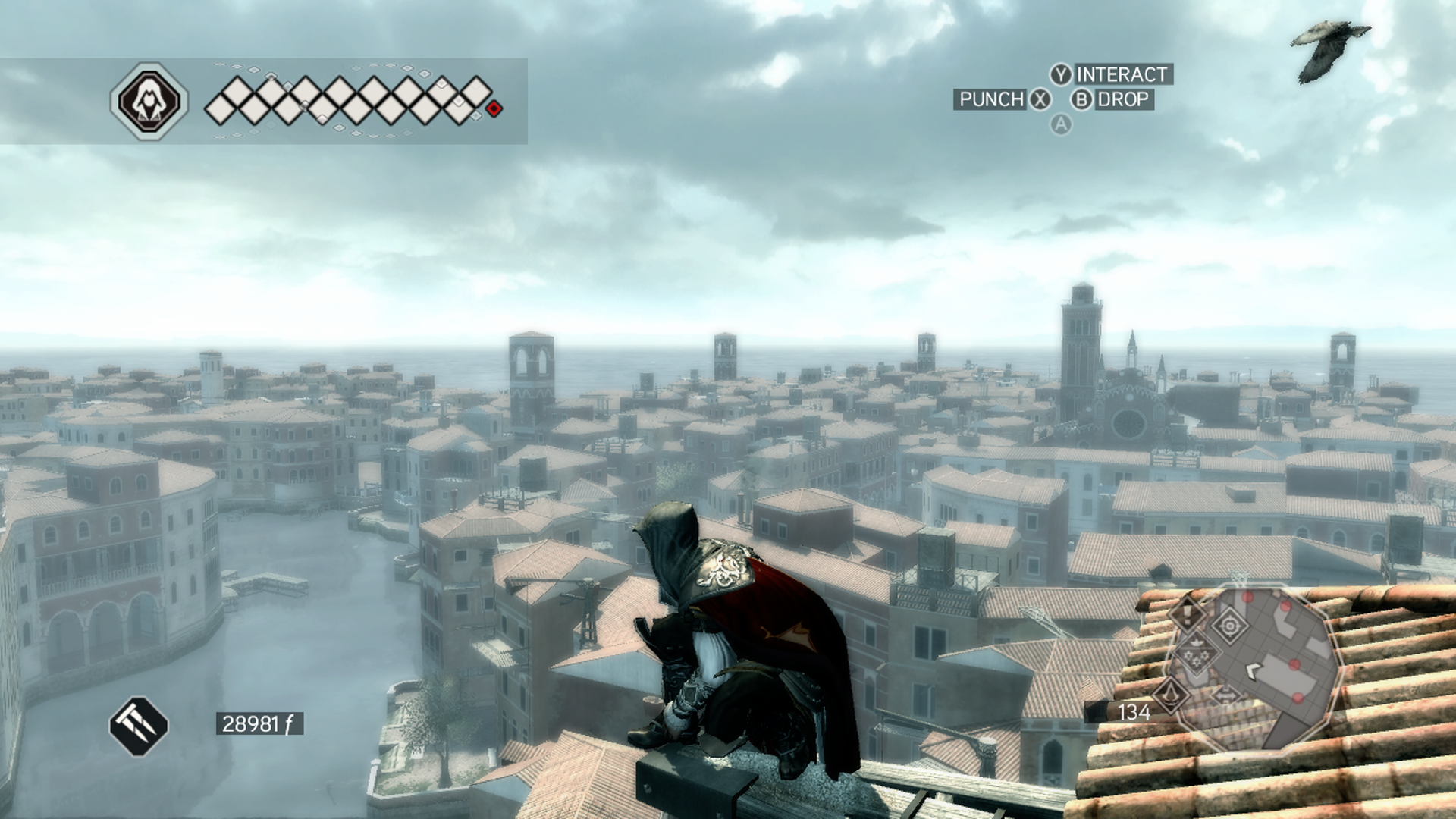
The game franchise that has since blown up continually teaches players about history and culture in a way that any high school history teacher cannot. Assassin’s Creed follows the Assassin Brotherhood as it evolves through different eras and locations. The first installment followed the third Crusade in Jerusalem, the second followed the Renaissance in Italy, the third followed the colonization of America, and so on and so on. The best thing about this franchise is the way it follows history and also creates their own history. This teaches the player about the history revolving around the setting of the game while also creating a quasi-fictional world and story to draw the player in. Kurt Squire quotes a fellow writer Loewen in his book, Video Games and Learning: Teaching and Participatory Culture in the Digital Age, “Loewen begins his book “Lies My Teacher Told Me with ‘High school students hate history. When they list their favorite subjects, history invariably comes in last….Bor-r-ring is the adjective they commonly apply to it’(p.12)” (111). History lessons need a reboot and I can entirely relate with these surveyed children.
History has always helped put me into a good mid-school nap. But once I came across the wonders of Assassin’s Creed II, I fell into a historical hole regarding Leonardo Da Vinci. Your source of technological and weapon advancements in the game revolves around Leonardo Da Vinci. In the gameplay video here, the one mission requires you to use a flying machine to travel to a distant location and that flying machine was designed by Leo himself. A picture of his actual sketch is also provided. Ask any person about Good ol’ Leo and they’ll immediately respond with something about his paintings. Leo’s character in AC2 doesn’t even reference his paintings because, what many people do not know about him is that he was also a master inventor.
Leo actually sketched what is believed to be the first helicopter, he invented the parachute, and he invented the giant crossbow. Casey Boyle wrote a blog post that included a plethora of definitions of rhetoric where one person, Cicero described an object that uses rhetoric correctly as, “…the one whose speech instructs, delights, and moves the minds of his audience”. In this case, my interactions with Leo instructed me on his inventions, delighted me with gameplay and moved my mind by teaching me something new about this historical figure. All of this learning was inspired from my first mission where I meet Leo and he crafts my hidden assassin blade, something a boring, hour-long history lecture couldn’t have done for me.
Kurt Squire writes about using Civilization 3 (shown here) as a teaching outlet for kids. He found the children learned about the resources or certain advances of the respective regions in Civ3 without knowing it and then Squire and the teachers capitalized on those lessons by furthering their new-found knowledge. One kid said, “Location is important. Playing in America was easier”.  To which Squire explained that the player unknowingly acknowledged the importance of scientific discovery and how America’s role in scientific discoveries helped their play in the game. Other players liked playing in Egypt because of their surplus of gold where the teachers then taught the players about the importance of the Nile River and the Egyptian and their reliance on gold. When reflecting on his tests, Squire explains, “We tried many teaching approaches, but found the most success when teaching and learning activities were in direct response to game play challenges” (138). So when these teachers combined a lesson with the game that was already in the process of teaching the children, it helped solidify all of the information those children learned through playing this video game. This technique combines all of the aspects of learning: visual, auditory, reading/writing, and partly kinesthetic and teaches a lesson in a way that can be accepted by all kinds of learners.
