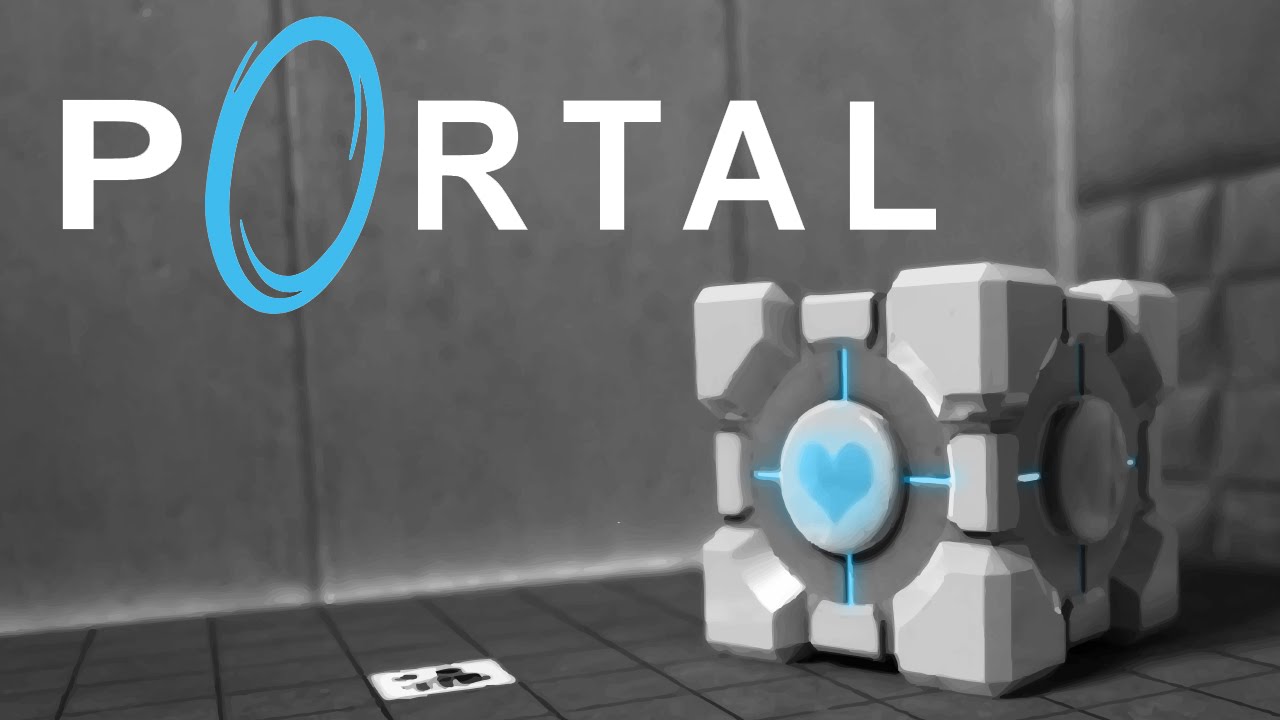
A small step above the basics I’ve mentioned before, Portal is a notable game that every gamer needs to have in the resume of games. Portal has an interesting visual and auditory aesthetic to it. The game is set in a training facility where the narration and instructions are given by an AI named GLaDOS. Spoilers (but if you have yet to play Portal or couldn’t figure out by the first couple seconds of gameplay, you’re slacking) you come to find that GLaDOS is the actual villain of the story and your character needs to break free from her “tests”. Each of her tests are the puzzles you are supposed to complete in the game by using your portal gun; hence the name of the game – Portal.
You’re equipped with a what GLaDOS so cleverly calls a portal gun. The capabilities of the gun is that you can shoot it and it creates a two- way portal. The use of the game is what takes this game a step above in teaching cognitive skills. The puzzles involve using basic physics and spatial awareness to solve these problems. You can use the portal gun to jump from one area to another by placing one portal behind you and another off a high jump. Then when the player jumps off the high jump, they are shot out of the other portal and across the edge to their desired destination. Explaining the puzzles of Portal is insanely difficult and made me feel a little dizzy just trying to explain them so a teaser trailer of the game that displays some of the puzzles the gamer encounters is included on this page. If you’re good at pausing at the right time, 1:17 shows a quick diagram of exactly what I’m trying to convey amongst other puzzles throughout the game.
Portal teaches players two things. One, it teaches players the cognitive skill of spatial awareness and two, a very basic understanding of physics that can help the player manipulate it for their puzzles. Isabela Granic writes about what video games have to give us in her article called The Benefits of Playing Video Games. Regarding the benefits gamers experiences, she writes “These cognitive enhancements are likely a product of the visually rich three-dimensional navigational spaces and the fast-paced demands that require split-second decision making and acute attention to unpredictable changes in context” (69). This is nearly the definition of Portal’s primary purpose. It’s a rich three dimensional space with fast-paced demands that require split-second decisions to the changes in context for the player to advance to the next puzzle.
The benefits that Portal gave me as gamer were causing me to change the way I look at certain puzzles whether in video games or real life. It helped me to think outside the box whenever I come across new challenges and it helped me gain some knowledge about physics. Being in a first person view also helped because the view gave me a sense that I was the one actually in the puzzle rather than watching my character perform the tasks from a third person view. The first person view helped draw me into the game and at the same time, furthered the impact the game had on my problem solving and physics.
