
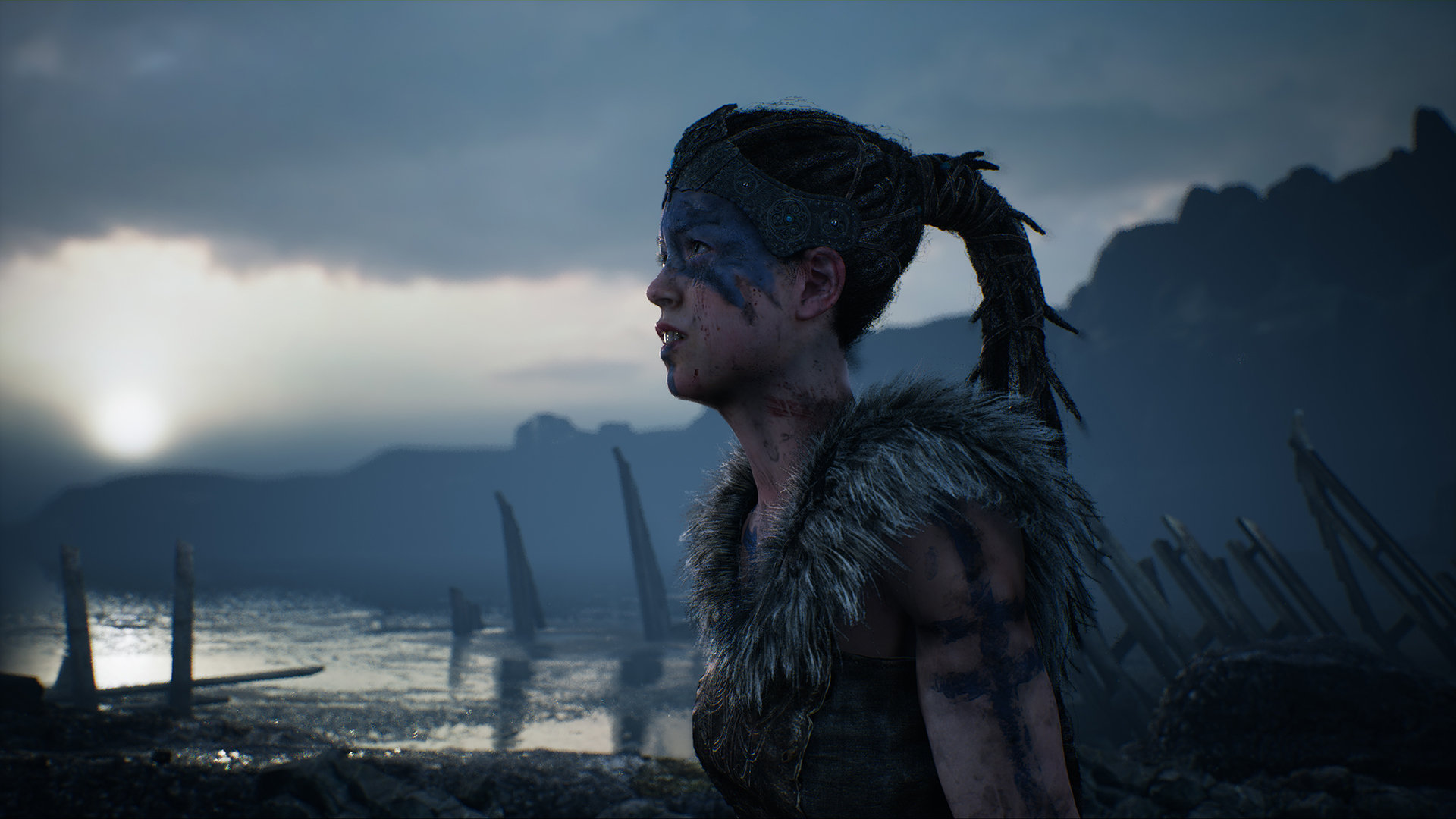
Hellblade: Senua’s Sacrifice is an indie game that was released at $30 compared the normal AAA release price at $60. The game follows our character Senua who goes on a journey to Hel in order to recover the love of her life in a trial against demons and puzzles. Senua is a female warrior that fights against massive adversaries that tower over her but the player is challenged with finding a way around these characters and defeating them by using Senua’s small size to her advantage. The real beauty of this game though is in the immersion that this game pulls you into, whether you like it or not.
The big mechanic revolving around this game is that the main character Senua has psychosis. The game could have been a kind of scary game similar to Dark Souls where the story is strictly about what’s on the surface but instead, the developers gave the main character a devastating disorder and completely changed the entirety of the game. When talking about this difference in design choices in his article Rhetoric of Video Games, Ian Bogost writes “Some games’ procedural representations serve mostly to create an entertainment experience, a fantastic situation that transports the player to another world. But other games use procedurality to make claims about the cultural, social, or material aspects of human experience” (123). The game designers created a situation that is an entertaining moment and a teaching moment at the same time by making psychosis their primary source for game mechanics. It’s done in an entirely terrifying way but it’s meant to aid the player in a way while also allowing them to experience what psychosis is like.
The symptoms of psychosis include anxiety, suspiciousness, delusions, hallucinations, depression, and many more. Instead of those symptoms being completely disabling for our character, the player is actually suppose to use them to their advantage. They help tell the gamer all about what to do, what is happening, and the character’s current state. If you don’t play this game with headphones, you are missing out entirely. One of the stated symptoms of psychosis is the presence of hallucinations which can be auditory or visual. Auditory hallucinations are present throughout the entire game. The character of Senua hears voices in her head no matter the situation and the way that the game amplifies this factor for the player’s experience is the use of omnidirectional sound.
Omnidirectional sound is when you seem to hear sounds coming from all different directions when it’s actually a clever ability that headphones have; to give the illusion that you can hear sound from multiple directions when you really only hear from the left and the right. Using this ability, the player will be able to hear the same voices that Senua hears in all different directions. This gives the player the same experience that someone with psychosis would experience. The best part is that the voices are used to heighten terror in the player in various situations and also help the player with directions.
For instance, when in battle with an enemy, the voices will sometimes yell, “Behind you!” when an enemy is about to attack Senua from behind which you should be able to see in the video provided. Another example of the voices being helpful is when you’re not battling anything and trying to find your next objective, the voices will discuss about what she needs to do and why she needs to do it. Then, when the player is wandering through a dark area, the player will be able to hear the voices whispering, “Where is she going?”, “She’s going to die!”, or “Why won’t she turn back?”. It adds for a terrifying playthrough but it really gives you a sense of another human’s perspective in the real world.
As for the other symptoms, we as players just assume they are part of the story or our character and that is what makes this game’s purpose most effective like visual hallucinations or delusions in puzzles, our main character experiencing depression from the story, and difficulty concentrating which is definitely true in this game with so many different things happening in only two of our five senses. Tania Smith writes in her article about rhetoric that “…the most powerful forms of rhetoric are those that hide their own strategies and intentions” (“What is Rhetoric”). Gamers don’t assume the game is intending to teach us about psychosis because we just assume that these are the game mechanics used to make the game more terrifying. I learn most from experience, not from being told, so when I could have the experience of psychosis while also experiencing an interesting story, beautiful gameplay, and brutal sword-fights, I retained my experiences and as a result, empathized and saw a new perspective for those that suffer from this condition.
