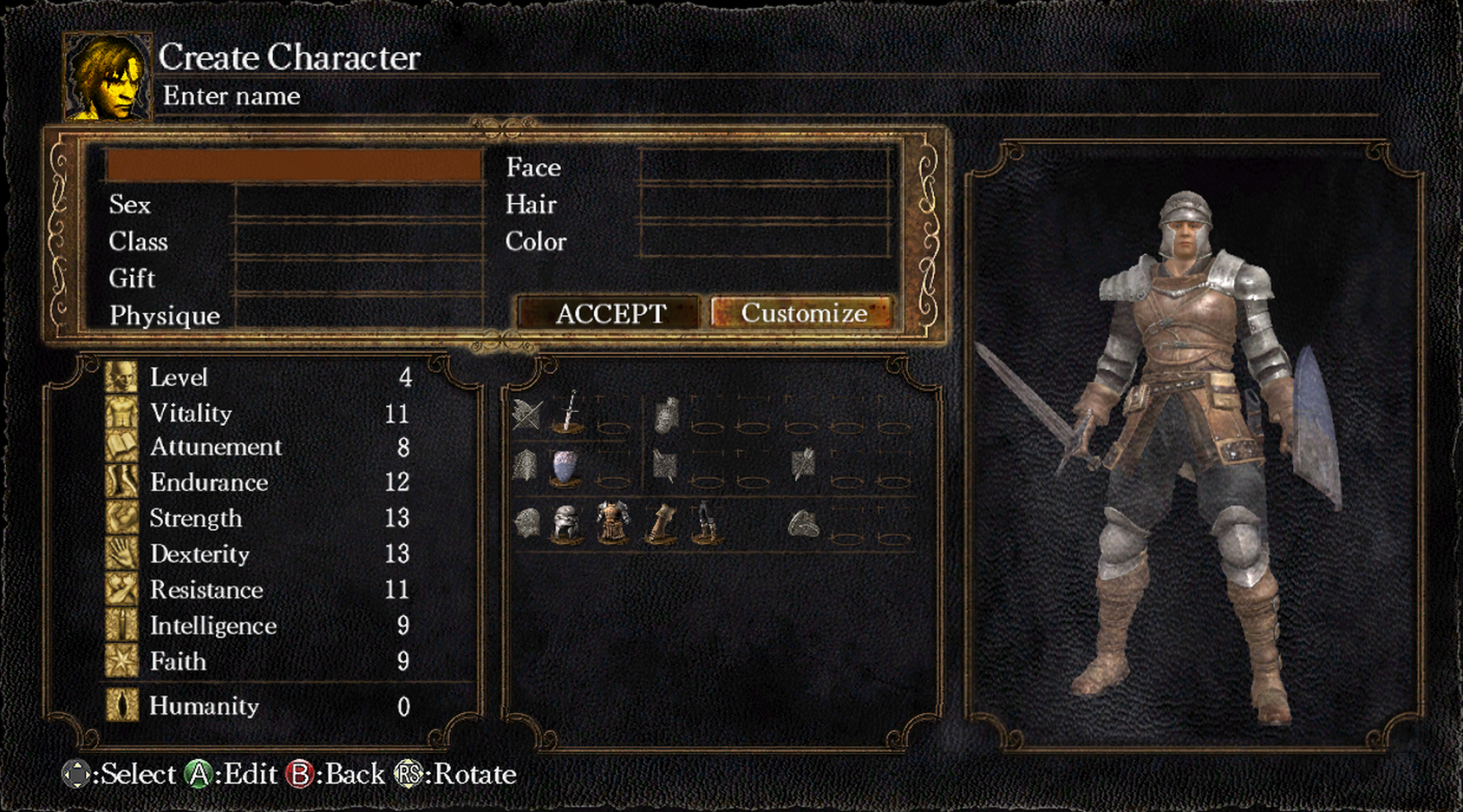
This is the case with the character creation process in Dark Souls, as well – both games have impressively extensive customizability. Just like in Oblivion, players can make their Dark Souls avatar look anywhere from extremely serious, intimidating, and heroic to the total opposite: casual, funny, and entirely malformed. And Dark Souls allows its players to accompany their character design with a wide array of gear that can be used to accentuate the personality and style of each avatar – just a bit more so than Oblivion does. Some players may choose to equip their character with a massive, two-handed greatsword or bludgeon if they are going for an avatar that intimidates and threatens with brute force. They might even wear bulky and heroic plate-armor to match, creating the appearance of a tank, of a hulk that shouldn’t be messed with. Some players may choose to use light leather armor, a dark, hooded cloak, a crossbow, and a pair of daggers if they want to live out a life of stealth and trickery in game. Some players, however, might run around in the nude or with some piece of goofy joke-gear. These are just some basic examples, but, realistically, there is no true limit on what each player can choose to adorn their avatar with. “Not only is man what [they] conceive [their self] to be, but [they] [are] also only what [they] will [their self] to be after this thrust toward existence” (Sartre 345).
What Dark Souls also brings to the table is that it can be played as both single-player and multi-player, rather than just single-player. Players can choose to play the game alone, without ever encountering other players, by switching to Offline Mode. On the other hand, if players want to interact with the community while they play, they can choose Online Mode, allowing them to fight bosses with other players, fight to the death against other players (whether just for the ~Thrill of the Kill~ or for dominion over a particular region of the game’s world), or anything of the sort. An in-game element such as this means that Dark Souls can be played in a manner that allows the player to run their own fantasy of identity without having to worry about the impressions it might make on other players (like in Oblivion), as well as in a manner that allows the player to submit their avatar’s identity out into the public sphere, to be inevitably judged by other players. This is an important distinction to make when moving on to the next example, RuneScape 2 (Old School RuneScape).
